
Asphalt
CITYOFTECH
FRM WaterProof Asphalt Concrete
Overview
- FRM waterproof asphalt concrete is a non-permeable paving material with waterproofing properties, which can be applied to bridges and underpasses without a waterproof layer.
- It has been tested and verified for its water penetration blocking effect and durability.
- FRM waterproof asphalt, with appropriate particle-size distribution, optimal asphalt content, filler usage, and a large amount of waterproof additives (composed of asphalt modifiers, fine fillers, adhesives, etc.), increases the lifespan of the pavement.
- It is a non-permeable paving material with a porosity of 2% or less.A3
Features
1. Mixing characteristics
- Among the special additives, fine fillers fill the fine pores of the mixture.
- The combination of cellulose fibers, elastic materials, and modifiers (PG82-22 or higher) enhances the workability and durability of the mixture.
- Elastic materials enhance the resistance to vibrations in bridges.
- Asphalt modifiers increase the viscosity of the asphalt and enhance its adhesion.
2 Mixing conditions
- Appropriate particle-size distribution of aggregates : Minimizing porosity
- Use of filler at least 7% : Reduction of porosity
- Use of at least 6.5% asphalt : Optimization of particle-size distribution, Porosity management
- Use of modified waterproof additives with a PG82-22 rating or higher : Composed of fine fillers, elastic materials, and mediators
- Porosity of 2% or less : Impermeable layer (For surface layers, porosity is 2~4%)
3. Application
- For deck waterproofing (concrete slabs, steel decks), elevated bridges, underpasses, and a middle layer for low-noise pavements
4. Tack coat
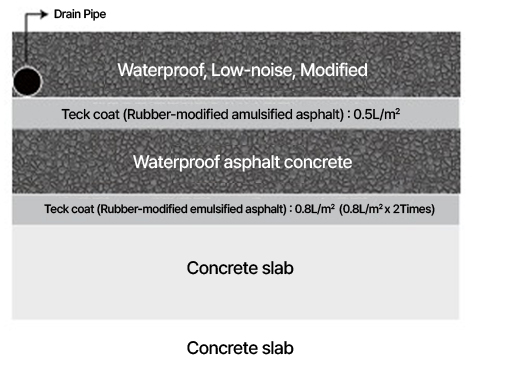
- Rubber-modified emulsified asphalt must be used for tack coat application.
- Joint areas in the structure should be sprayed twice. (Absorption layer + Bonding layer)
- In case of using normal emulsified asphalt, it may cause re‐emulsify upon contact with water and reduce the durability of the pavement.
Comparison of bridge surface paving methods
| Normal asphalt concrete | FRM Waterproof asphalt concrete | |
|---|---|---|
| Cross sectional drawing | 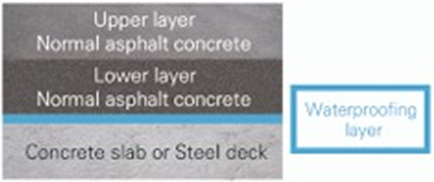 |
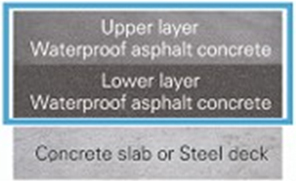 |
| Waterproof layer | Additional waterproofing layer is required. | Additional waterproofing layer is not required. |
| Durability | PG64-22 ~ PG76-22 |
|
| Functionalitty |
|
|
| Constructability |
|
|
| Cost-effectivenss |
|
|
Compared to Normal Asphalt Concrete
| Test items | Unit | Function | Quality Standards | |
|---|---|---|---|---|
| Normal asphalt concrete | FRM Waterproof asphalt concrete | |||
| Marshall stability | N | Strength and durability | 6,000 or more | 6,000 or more |
| Porosity | % | Water tightness | 3~6 | Under 2 |
| Permeability coefficient | cm/sec | Water permeability | - | No permeability |
| Indirect tensile strength | N/mm2 | Crack resistance | 0.8 or more | 0.9 or more |
| Dynamic stability | time/mm | Plastic deformation resistance | 1,000 or more | 2,000 or more |
| Cantabro loss (20℃) | % | Resistance to aggregate spalling | - | Under 15 |
| Skid resistance | BPN | Slip resistance | - | 60 or more |
Construction Site
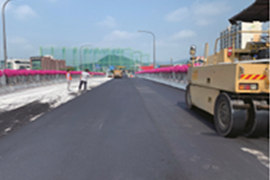
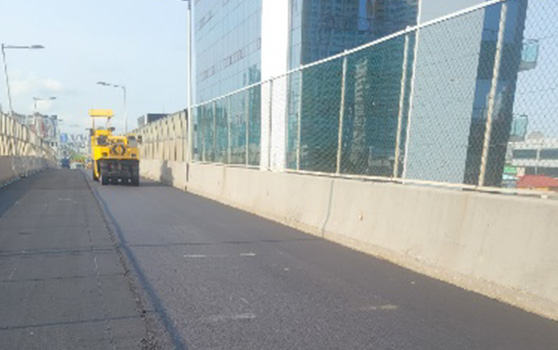
Dongducheon-si
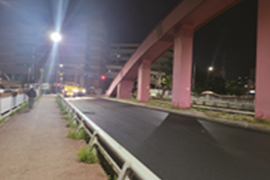
Yongin-si, Suji-gu
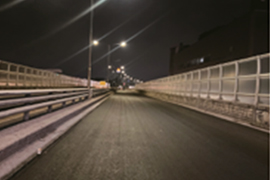
Gwonseon District, Suwon-si
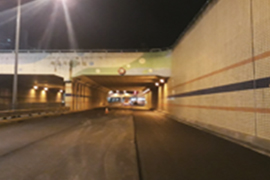
Asan-si
Applications
Bridges
- Structural drawing
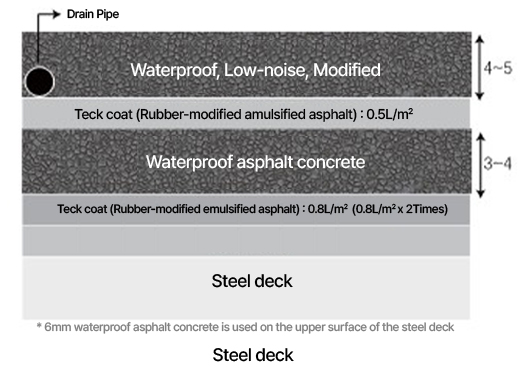
Underpass and Overpass
- Structural drawing
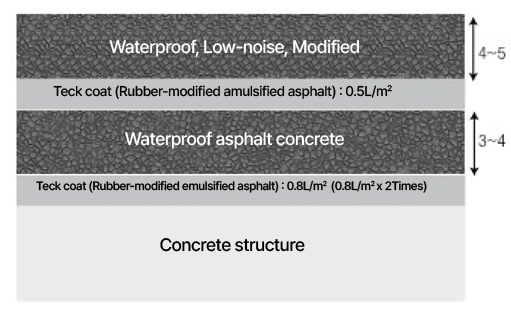
Treatment of Joint Sections (Cold Joint)
During tack coat application after waterproof asphalt pavement, a sufficient amount of rubber-modified emulsified asphalt should be sprayed to the cold joint. (Enough to flow on the surface)
How to Repair
- ① After cutting to the lower layer, apply rubber emulsion.
- ② Load ton-bag waterproof asphalt concrete into the Mobile Asphalt Production Facility, then heat and mix.
- ③ Lay the mixture in the repair area and compact using a compactor or roller (Lower layer).
- ④ Apply a sufficient amount of rubber emulsion on the lower pavement surface to prevent water infiltration.
- ⑤ In accordance wit the type of surface layer (Waterproof, Modified, Low-noise), load the ton-bag asphalt concrete into the facility.
- ⑥ Heat, and mix.
- ⑦ Lay the mixture in the repair area and compact using a compactor or roller (Upper layer).
 Company : City of Tech co., LTD
Tel : +82 31 266 7465 Fax : +82 31 266 7079 Email : cityoftech@naver.com
Office : 27, Hosu-ro 52beon-gil, Suji-gu, Yongin-si, Gyeonggi-do, Republic of Korea
Factory : 39-13, Daejesandan 1-gil, Goesan-eup, Goesan-gun, Chungcheongbuk-do, Republic of Korea
Company : City of Tech co., LTD
Tel : +82 31 266 7465 Fax : +82 31 266 7079 Email : cityoftech@naver.com
Office : 27, Hosu-ro 52beon-gil, Suji-gu, Yongin-si, Gyeonggi-do, Republic of Korea
Factory : 39-13, Daejesandan 1-gil, Goesan-eup, Goesan-gun, Chungcheongbuk-do, Republic of Korea
Copyright 2023 City of Tech co., LTD. All rights reserved. Designed by Website.co.kr